
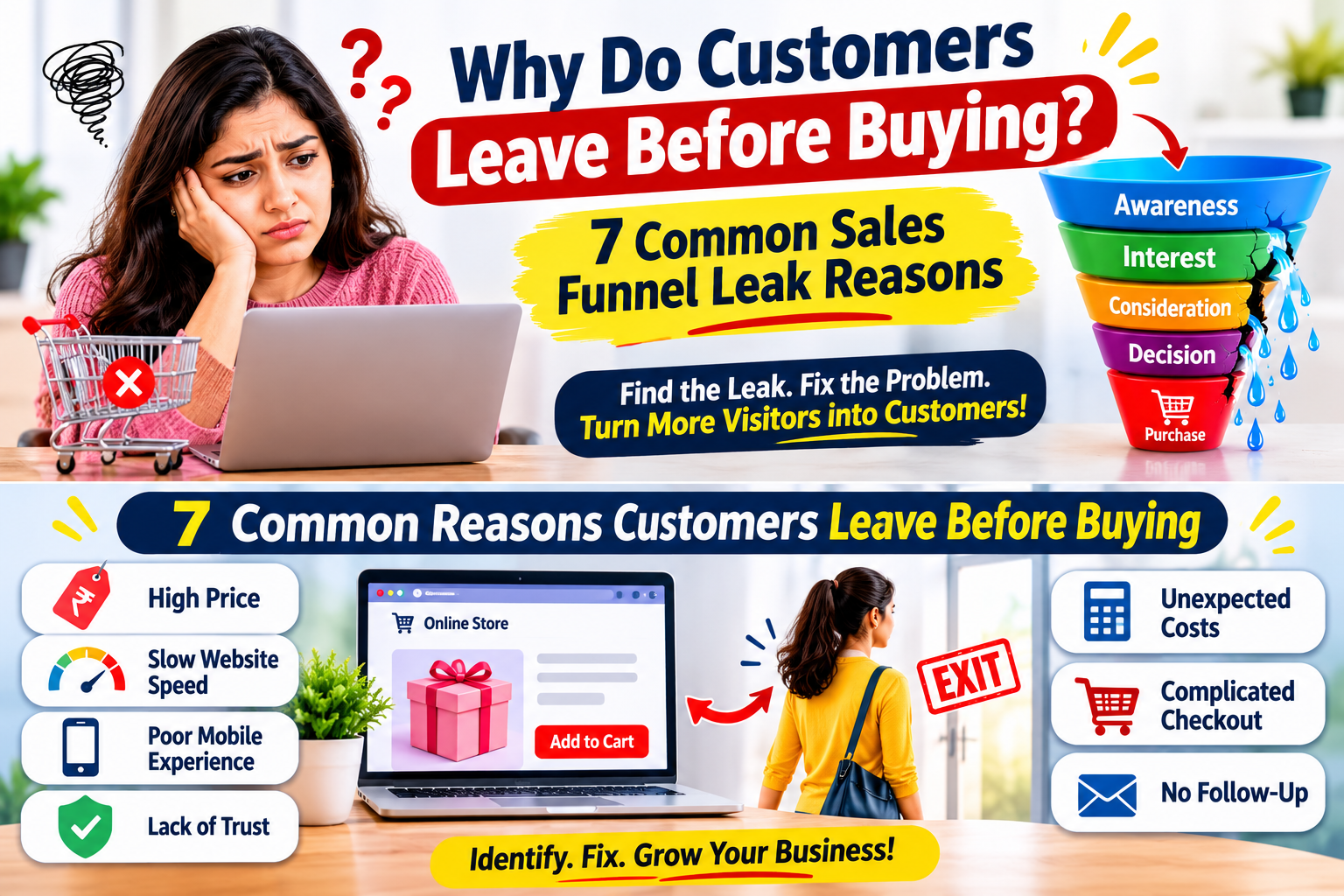
Why do visitors leave without buying? Discover 7 common sales funnel leaks and practical fixes to turn more visitors into paying customers.
You spend time and money driving traffic to your website. Visitors arrive, browse, maybe even add something to their cart, and then they vanish. No purchase, no sign-up, no goodbye.
If this sounds familiar, you have sales funnel leaks. A leak is any point where potential customers drop out before completing the action you want them to take. The good news is that most leaks follow predictable patterns, and once you spot them, they are fixable.
In this guide, we break down why customers leave before buying and what you can do about each reason.
What Is a Sales Funnel Leak?
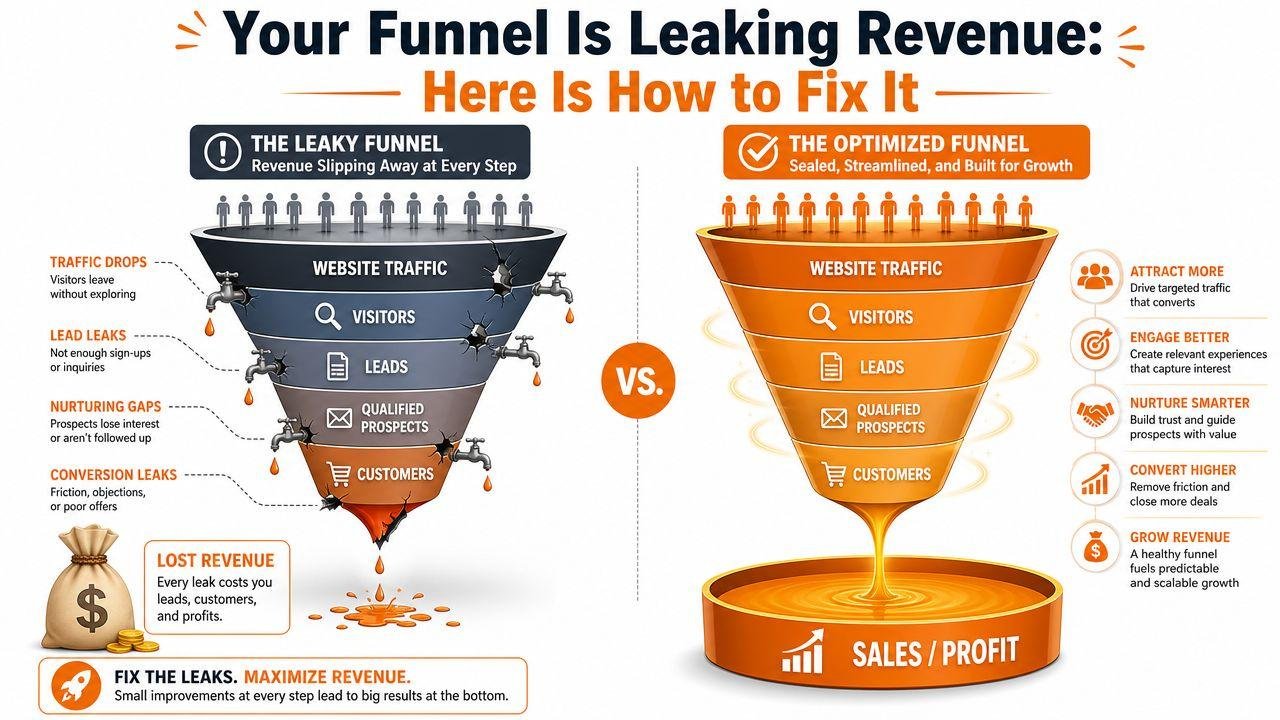
A sales funnel maps the journey from first contact to purchase: Awareness → Interest → Consideration → Decision → Purchase. A leak happens when people exit that journey early. Even a small leak at the top of the funnel can cost you a large share of revenue at the bottom, because every stage multiplies the loss.
Now let’s look at the seven most common causes. Want to see how this plays out in real life? Read our complete case study of a sales funnel leak in the finance sector.
1. Unclear Value Proposition
If visitors can’t tell within a few seconds what you offer and why it matters, they leave. Vague headlines like “Solutions for a better tomorrow” tell people nothing.
How to fix it:
- Write a headline that states exactly what you do and who it’s for.
- Add one supporting line explaining the main benefit.
- Test your homepage on a stranger: can they explain your offer after five seconds?
2. Slow Website Speed
Page speed directly affects bounce rate. People are impatient, especially on mobile, and a page that drags will lose visitors before they ever see your offer.
How to fix it:
- Compress and resize images.
- Use caching and a reliable hosting provider.
- Remove unnecessary plugins and scripts.
- Check your performance with Google PageSpeed Insights.
3. Poor Mobile Experience
A large share of web traffic comes from phones. Tiny buttons, text that needs zooming, or forms that are painful to fill in push mobile users away fast.
How to fix it:
- Use a responsive design.
- Make buttons large enough to tap easily.
- Keep forms short and use auto-fill where possible.
- Test the full buying journey on a real phone, not just a desktop preview.
4. Lack of Trust and Social Proof
People hesitate to buy from a business they don’t trust. Missing reviews, no contact details, and no security signals all raise doubt.
How to fix it:
- Display genuine customer reviews and testimonials.
- Show trust badges, secure payment icons, and clear return policies.
- Add an About page, a real address or contact option, and case studies where relevant.
5. Unexpected Costs and Pricing Confusion
Surprise shipping fees, taxes, or hidden charges at checkout are among the biggest reasons for cart abandonment. Confusing pricing pages create the same hesitation earlier in the funnel.
How to fix it:
- Be upfront about total costs, including shipping and taxes.
- Keep pricing simple and easy to compare.
- Offer a clear explanation of what’s included in each plan or product.
6. Complicated or Lengthy Checkout
Every extra form field, forced account creation, or confusing step gives the customer one more reason to quit. At this stage they already want to buy, so friction here is especially costly.
How to fix it:
- Offer guest checkout.
- Reduce the number of fields and steps.
- Provide multiple payment options, such as cards, UPI, wallets, and cash on delivery where suitable.
- Show a progress indicator so people know how close they are to finishing.
7. No Follow-Up with Hesitant Visitors
Not everyone buys on the first visit. Many people need more time, more information, or a gentle reminder. If you don’t follow up, you let warm leads go cold.
How to fix it:
- Send abandoned cart emails or messages.
- Capture emails with a useful lead magnet or newsletter.
- Use retargeting ads to bring visitors back.
- Answer common objections with FAQs, live chat, or short explainer content.
How to Find Your Own Funnel Leaks
Before fixing anything, locate where people actually drop off:
- Check analytics. Use Google Analytics to see which pages have the highest exit rates.
- Watch behavior. Heatmaps and session recordings show where visitors get stuck.
- Ask customers. Short exit surveys reveal reasons data can’t.
- Test one change at a time. A/B testing helps you learn what really improves conversions.
For a step-by-step example of spotting and fixing leaks, see our guide on how to find and fix a sales funnel leak.
Final Thoughts
Customers rarely leave without a reason. Whether it’s a confusing message, a slow page, a lack of trust, or a clunky checkout, each leak is a chance to improve. Start with the biggest drop-off in your funnel, fix it, measure the result, and move on to the next.
Plugging even a few of these leaks can raise your conversion rate without spending a rupee more on traffic.
Which of these leaks do you think is costing your business the most? Share your thoughts in the comments below.
FAQ
Why do customers leave before buying?
The most common reasons are an unclear offer, slow loading, poor mobile experience, lack of trust, unexpected costs, a complicated checkout, and no follow-up.
What is a sales funnel leak?
It’s any stage in the buyer’s journey where potential customers drop out before completing a purchase or desired action.
How do I reduce cart abandonment?
Show total costs early, simplify checkout, offer guest checkout and multiple payment options, and send reminder emails.
How can I find where my funnel is leaking?
Use analytics to spot high-exit pages, add heatmaps or session recordings, and collect feedback from visitors who didn’t buy.
 Shreyan
 Biswaranjita