
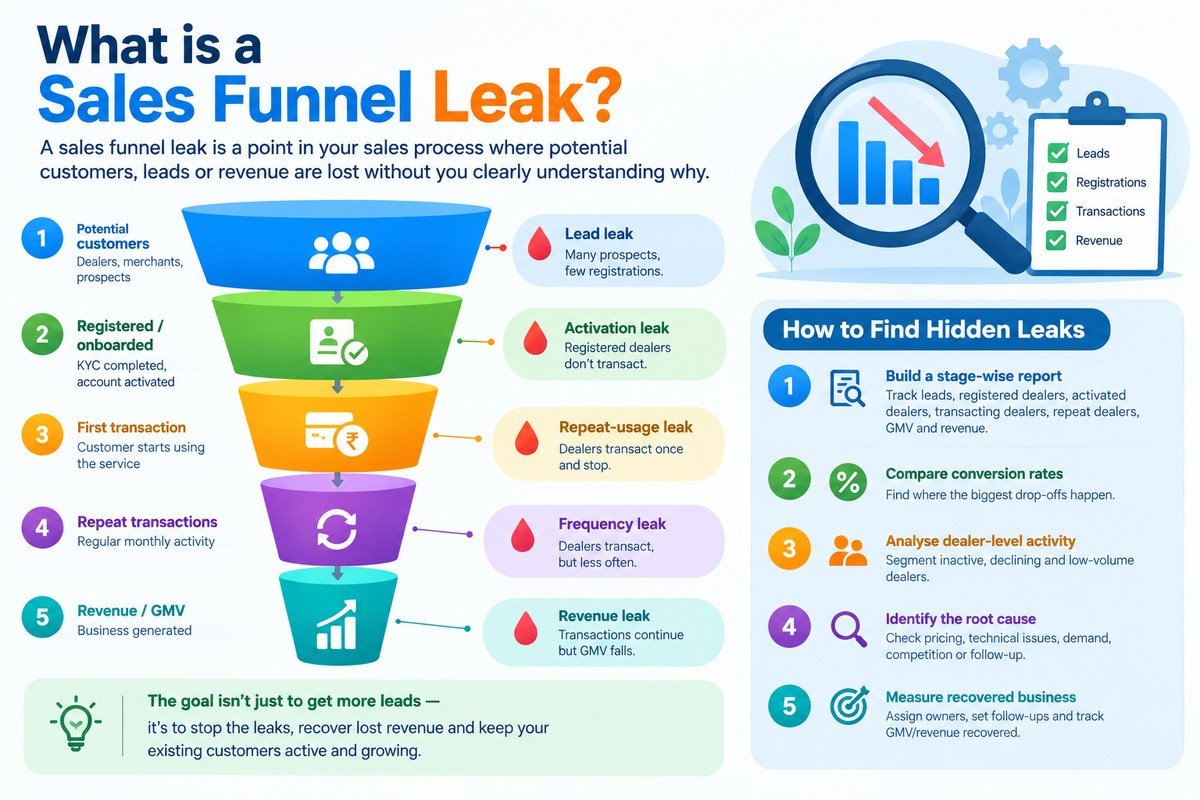
You get visitors. You get enquiries. But sales stay low?
Let me explain about what is A Sales Funnel ..
A sales funnel is the step-by-step journey a potential customer follows, from discovering your business to finally purchasing your product or service. It is called a funnel because many people may discover your business, but only some of them eventually become customers.
A sales funnel leak is a point in your sales process where potential customers, leads, or revenue are lost without you clearly understanding why. A hidden sales funnel leak is harder to detect because your reports may look normal, but sales are gradually declining.
For Example of banking and payment business, dealers may be registered and active on paper, but they may not be transacting regularly. This is a classic hidden funnel leak.
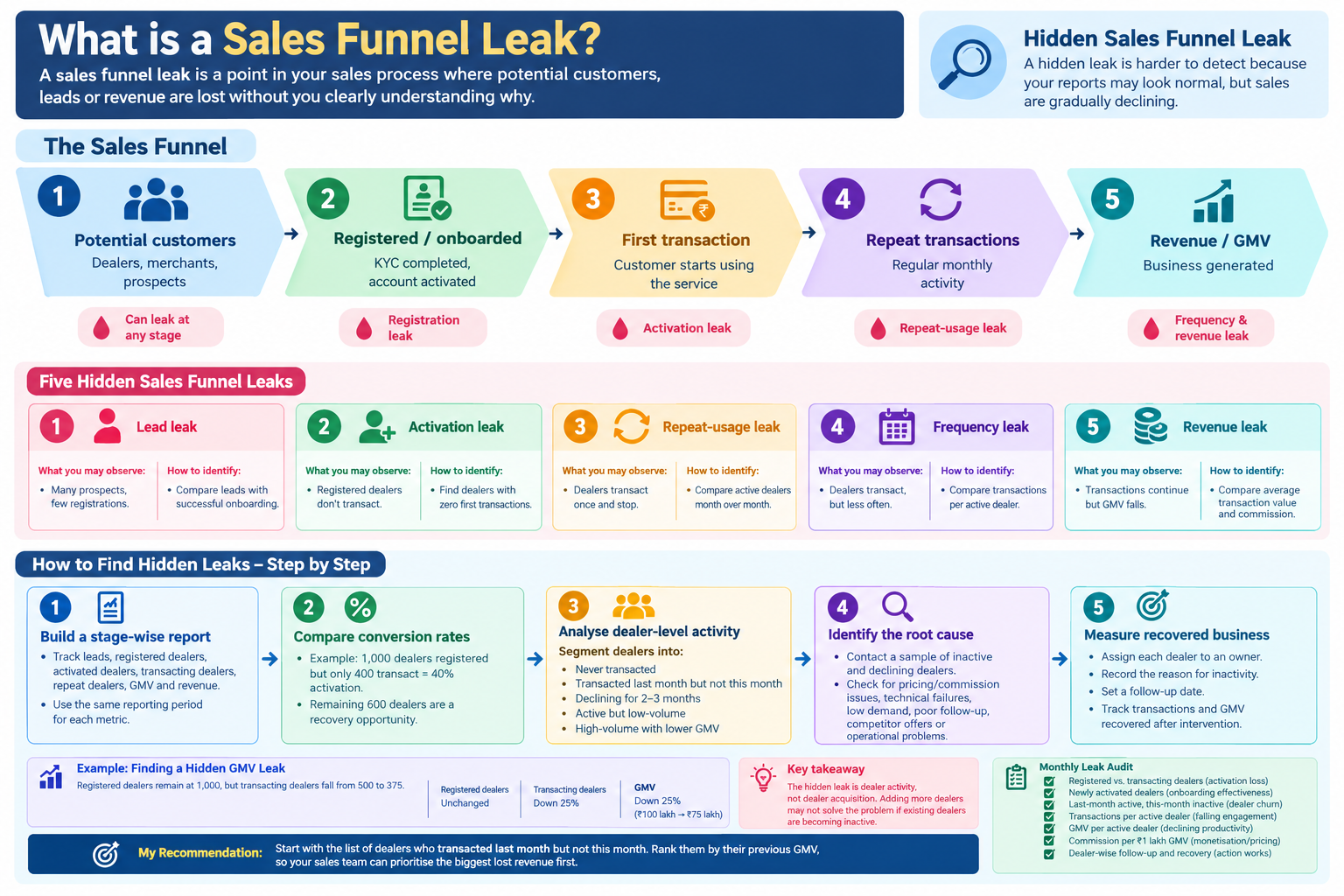
1. Understand the sales funnel
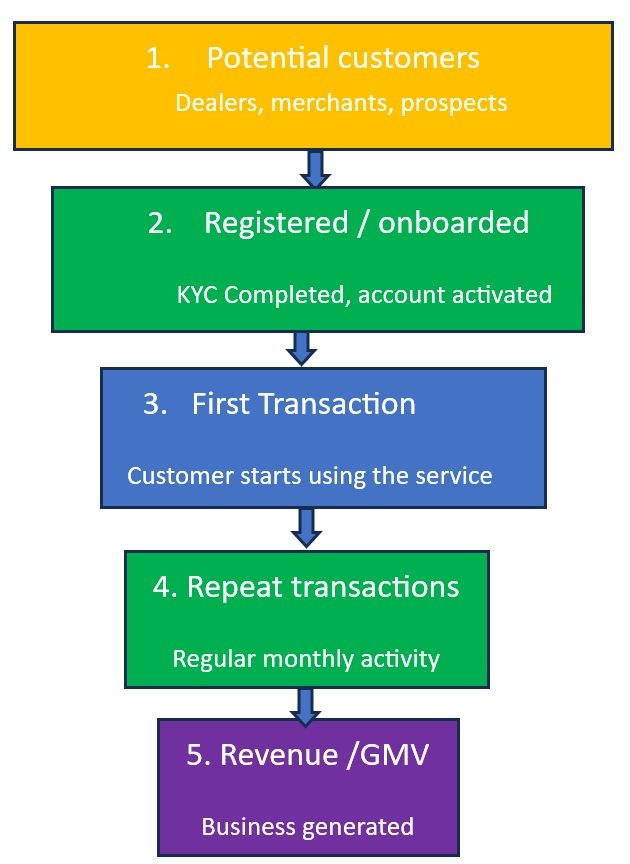
2. Five hidden sales funnel leaks
| Hidden leak | What you may observe | How to identify it |
| Lead leak | Many prospects, few registrations | Compare leads with successful onboarding |
| Activation leak | Registered dealers don’t transact | Find dealers with zero first transactions |
| Repeat-usage leak | Dealers transact once and stop | Compare active dealers’ month over month |
| Frequency leak | Dealers transact, but less often | Compare transactions per active dealer |
| Revenue leak | Transactions continue but GMV falls | Compare the average transaction value and commission |
3. How to find hidden leaks step by step
a. Build a stage-wise report.
Track leads, registered dealers, activated dealers, transacting dealers, repeat dealers, GMV and revenue. Use the same reporting period for each metric.
b. Compare conversion rates.
For example, if 1,000 dealers are registered but only 400 transact, activation is 40%. The remaining 600 dealers are a potential recovery opportunity.
c. Analyze dealer-level activity.
Segment dealers into: – Never transacted – Transacted last month but not this month – Transactions declining for 2–3 consecutive months – Active but low-volume – High-volume dealers whose GMV has dropped
d. Identify the root cause.
Contact a sample of inactive and declining dealers. Check for pricing or commission issues, technical failures, low customer demand, poor follow-up, competitor offers or operational problems.
e. Measure recovered business.
Assign each dealer to an owner, record the reason for inactivity, set a follow-up date, and track transactions and GMV recovered after intervention.
Note:- GMV stands for Gross Merchandise Value. GMV is the total monetary value of goods or services sold through a business or platform over a specific period, before deducting commissions, discounts, refunds, or other costs (depending on the reporting definition).
4. Example: finding a hidden GMV leak
Suppose your dealer network has the following monthly performance:
Monthly GMV trend
Illustrative figures showing how GMV can decline even when dealer registrations remain unchanged.
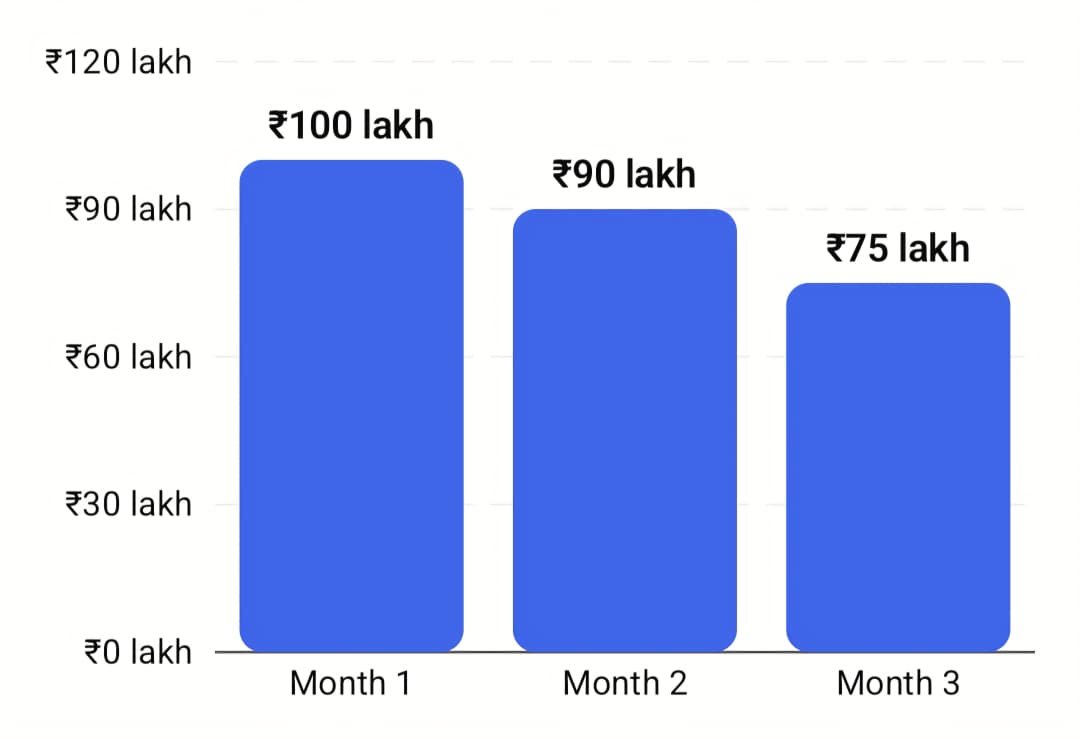
Assume registered dealers remain at 1,000, but transacting dealers fall from 500 to 375.
- Registered dealers: unchanged.
- Transacting dealers: down 25%.
- GMV: down 25%, from ₹100 lakh to ₹75 lakh.
The hidden leak is dealer activity, not dealer acquisition. Adding more dealers may not solve the problem if existing dealers are becoming inactive.
To confirm the cause, also check transaction frequency and average GMV per transacting dealer. These will show whether the problem is fewer active dealers, lower usage, or both.
5. A practical hidden-leak dashboard
Use this checklist in your monthly sales review.
| Monthly Leak Audit [ ] Registered vs. transacting dealers — Measures activation loss. [ ] Newly activated dealers — Measures onboarding effectiveness. [ ] Last-month active, this-month inactive — Identifies dealer churn. [ ] Transactions per active dealer — Detects falling engagement. [ ] GMV per active dealer — Detects declining dealer productivity. [ ] Commission per ₹1 lakh GMV — Detects monetization or pricing Changes. [ ] Dealer-wise follow-up and recovery — Checks whether corrective action works. |
Conclusion
Find Hidden Sales Funnel Leaks and Recover Lost Revenue
A sales funnel leak can silently reduce your conversions, customer engagement, and revenue without being immediately visible in your sales reports. Identifying these hidden leaks is essential for building a strong and profitable sales process.
To find and fix sales funnel leaks, track every stage of your funnel, monitor conversion rates, analyse customer behaviour, and identify where potential customers drop off. Pay special attention to inactive customers, declining transaction frequency, and falling revenue from existing customers. Understanding the root cause allows you to take corrective action instead of spending more money on acquiring new leads.
Remember, improving sales is not just about generating more leads; it is also about converting existing leads, retaining customers, and maximizing the value of every opportunity. By regularly reviewing your sales funnel and addressing hidden leaks, you can improve conversion rates, recover lost revenue, and achieve sustainable business growth.
 Shreyan
 Biswaranjita
 Anupd