
Everyone who is reading this article has probably heard of Meghalaya being called the “Land of Clouds” or the “Abode of Clouds.”
But have you ever wondered why? Is it simply because Meghalaya receives a lot of rain? Or is there something more interesting happening between its hills, forests and clouds?
And if you live in India, you probably already know that this country can surprise you with almost every kind of landscape. From the deserts of Rajasthan to the snow-covered mountains of Kashmir, tropical beaches in Goa and Kerala, and now… a place where the clouds seem to come down and live among the hills.
That place is Meghalaya.
And honestly, the name starts making sense the moment you see it and to understand why this name fits so perfectly, we have to look at something much deeper than the weather.
And I’m writing it because I went to Meghalaya a few days ago and noticed these things which I’m sharing below after a little research.
Now the first question, What Makes Meghalaya So Cloudy?
We need to look at the land itself.
Because Meghalaya’s clouds are not simply a result of a rainy climate. They are the result of a long interaction between tectonic activity, the shape and elevation of the land, atmospheric circulation, and the monsoon.
In simple terms:
Geology built the stage.
Meteorology brings the clouds.
And geography makes it rain.
A landscape shaped long before the clouds arrived.
A very long time ago Meghalaya formed by the Shillong Plateau, an ancient geological block in northeastern India. Its foundation contains some of the oldest rocks in the region, including Precambrian rocks that formed billions of years ago.
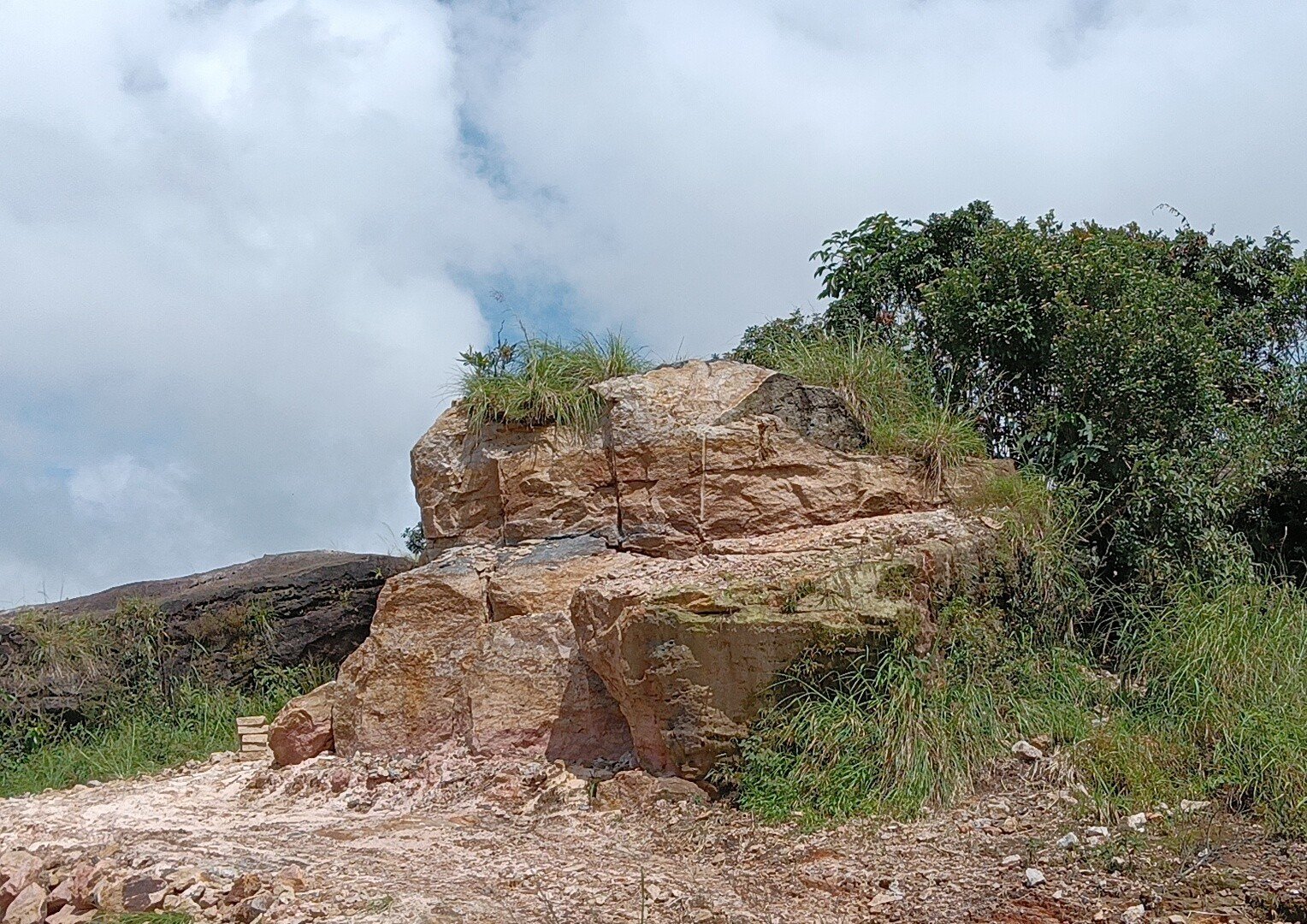
[Image of Precambrian rocks]
Of course, Meghalaya did not wake up one morning with its present-day hills, cliffs and valleys neatly arranged. Geological forces have been working on this region for an extraordinarily long time. Tectonic movements, uplift, faulting, weathering and erosion gradually shaped the plateau and its steep southern edge.
That southern edge is particularly important.
The Shillong Plateau rises sharply from the lowlands towards Bangladesh, while the Khasi and Jaintia Hills form a high, uneven landscape across much of central Meghalaya. In geological terms, this gave the region a very useful feature, elevation combined with a steep escarpment.
In meteorological terms, it gave the monsoon something rather inconvenient to run into. A mountain barrier. And that is where the story of Meghalaya’s clouds really begins.
Then the Bay of Bengal Sends in the Monsoon.
Every summer, the Indian monsoon carries vast amounts of moisture towards the subcontinent. For Meghalaya, one of the most important sources is the Bay of Bengal.
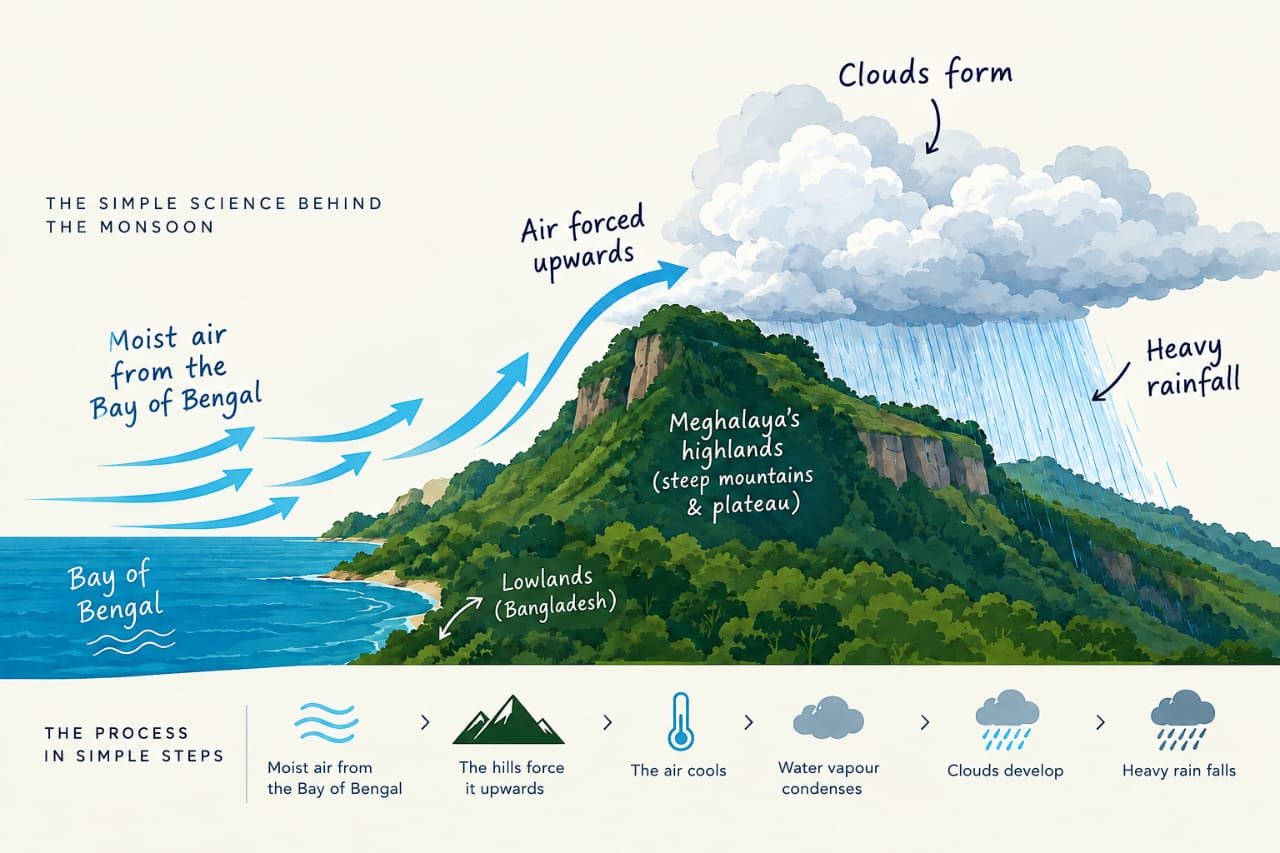
Warm, moisture-rich air moves north-eastwards and reaches the plains around Bangladesh and Assam. But as this air approaches the southern slopes of Meghalaya, it encounters the steep Khasi-Jaintia highlands.
The air cannot simply carry on at the same level. It is forced upwards by the terrain. This is known as orographic lifting.
As moist air rises, the surrounding atmospheric pressure decreases, allowing the air to expand and cool. As it cools, it reaches the point at which the water vapour it contains begins to condense into tiny droplets. Clouds develop, and when enough moisture condenses and the droplets grow, rainfall follows.
So, the process is not particularly mysterious once you break it down:
Moist air from the Bay of Bengal reaches the hills → the hills force it upwards → the air cools → water vapour condenses → clouds develop → heavy rain falls.
The mountains, in other words, are not merely standing there looking impressive. They are actively influencing what happens to the atmosphere above them.
But Why Does Meghalaya Get So Much Rain?
This is where things become more interesting.
There are mountains across India, and many of them receive heavy monsoon rainfall. So, why do places such as Sohra (Cherrapunji) and Mawsynram receive such extraordinary amounts? The answer lies in the rather unusual meeting of topography and monsoon winds.
The southern Khasi Hills rise quite unusually from the neighboring lowlands. During the southwest monsoon, moisture kept air from the Bay of Bengal reaches this steep terrain almost head-on. The air is forced upwards over a relatively short distance, producing strong uplift and develop those deep clouds.
The shape of the surrounding hills also helps concentrate and channel the moist airflow. This is why Meghalaya’s extreme rainfall cannot be explained by simply saying, “It rains a lot here.”
The real explanation is more like this: A huge supply of moisture + the right monsoon winds + a steep mountain barrier + repeated uplift = extraordinary rainfall.
And once you put those pieces together, Mawsynram and Sohra suddenly make a lot more sense.
The Clouds Are Only Half of the Story
There is another part of Meghalaya’s landscape that is easy to miss. The rain itself has been shaping the land.
For millions of years, water has been running over and through the rocks of Meghalaya. It has worn away exposed surfaces, cut channels into the hills and carried sediment into valleys and rivers. In areas where limestone is present, rainwater can also slowly dissolve the rock, gradually creating underground passages and caves.
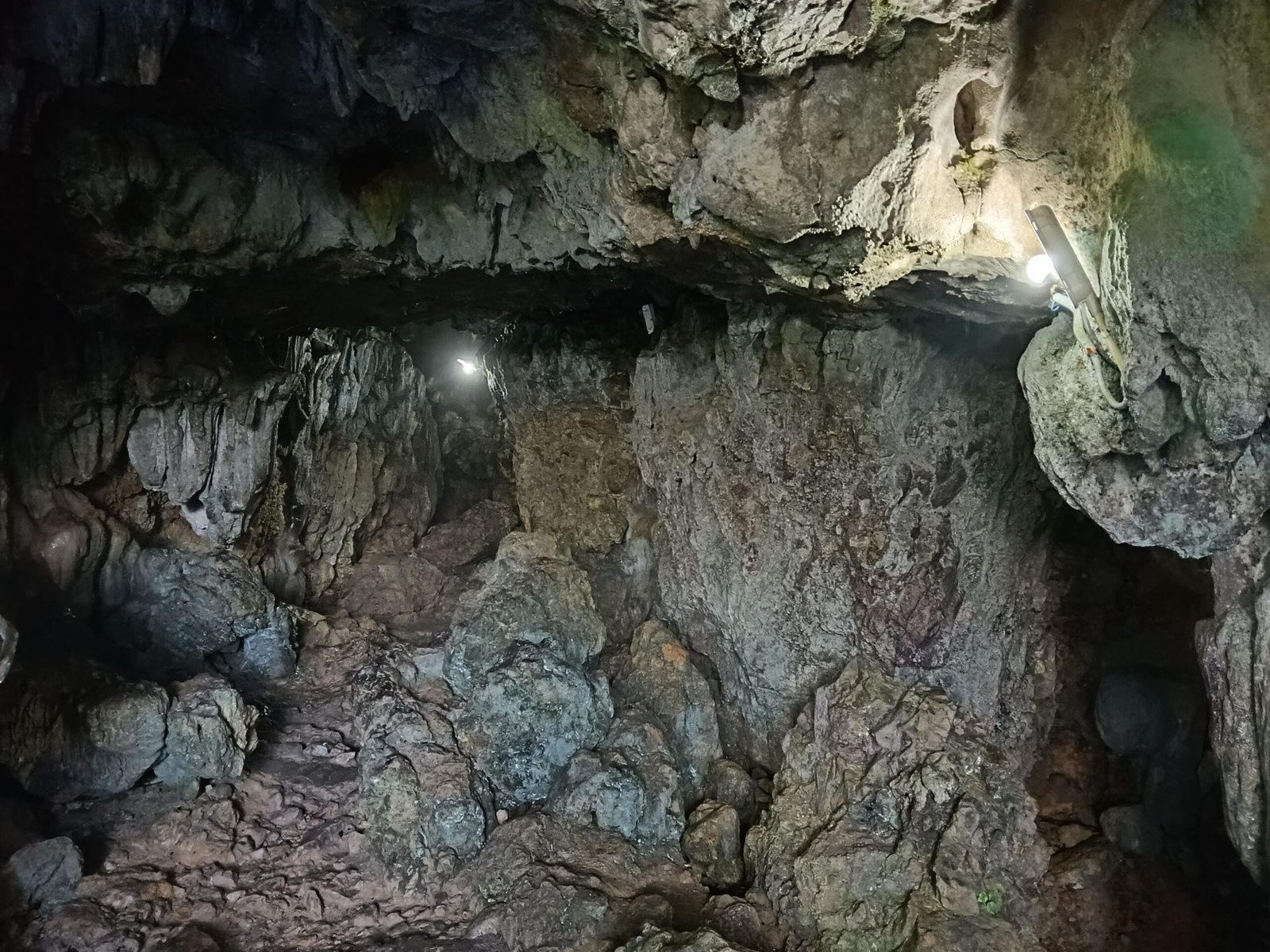
[Image of Mawsmai Cave]
This is one reason Meghalaya has such an extraordinary mixture of waterfalls, deep valleys, gorges, limestone caves and forest-covered hills.
Take the caves, for example. Rainwater absorbs carbon dioxide as it passes through the soil, making it slightly acidic. When this water moves through cracks in limestone, it can slowly dissolve the rock. Given enough time and by “enough” I mean geological amounts of it, those tiny cracks can develop into passages, chambers and extensive cave systems, and Mawsmai Cave is one of the examples I’ve shared but there’s a lot of caves, even cave systems you can visit.
So, that spectacular cave you visit is not simply a hole in the ground. It is the result of water, rock, chemistry and time working together. The waterfalls tell a similar story above ground.
The monsoon supplies the water; hills provide the height; Erosion keeps working on the rock and eventually, you get the dramatic cliffs and waterfalls that Meghalaya is famous for.
Geology Built the Stage and the Monsoon Uses It.
This is what makes Meghalaya particularly fascinating. It presents that the landscape is not the result of one event, it’s the product of processes operating at completely different timescales.
Geological processes shaped the Shillong Plateau over millions and billions of years and the monsoon changes Meghalaya’s weather within months. Rain and erosion continue modifying the landscape year after year.
The relationship looks something like this:
Ancient rocks → tectonic activity and uplift → Shillong Plateau → steep Khasi-Jaintia terrain → monsoon winds arrive → moist air rises → clouds form → heavy rainfall → erosion and weathering → there is our today’s Meghalaya.
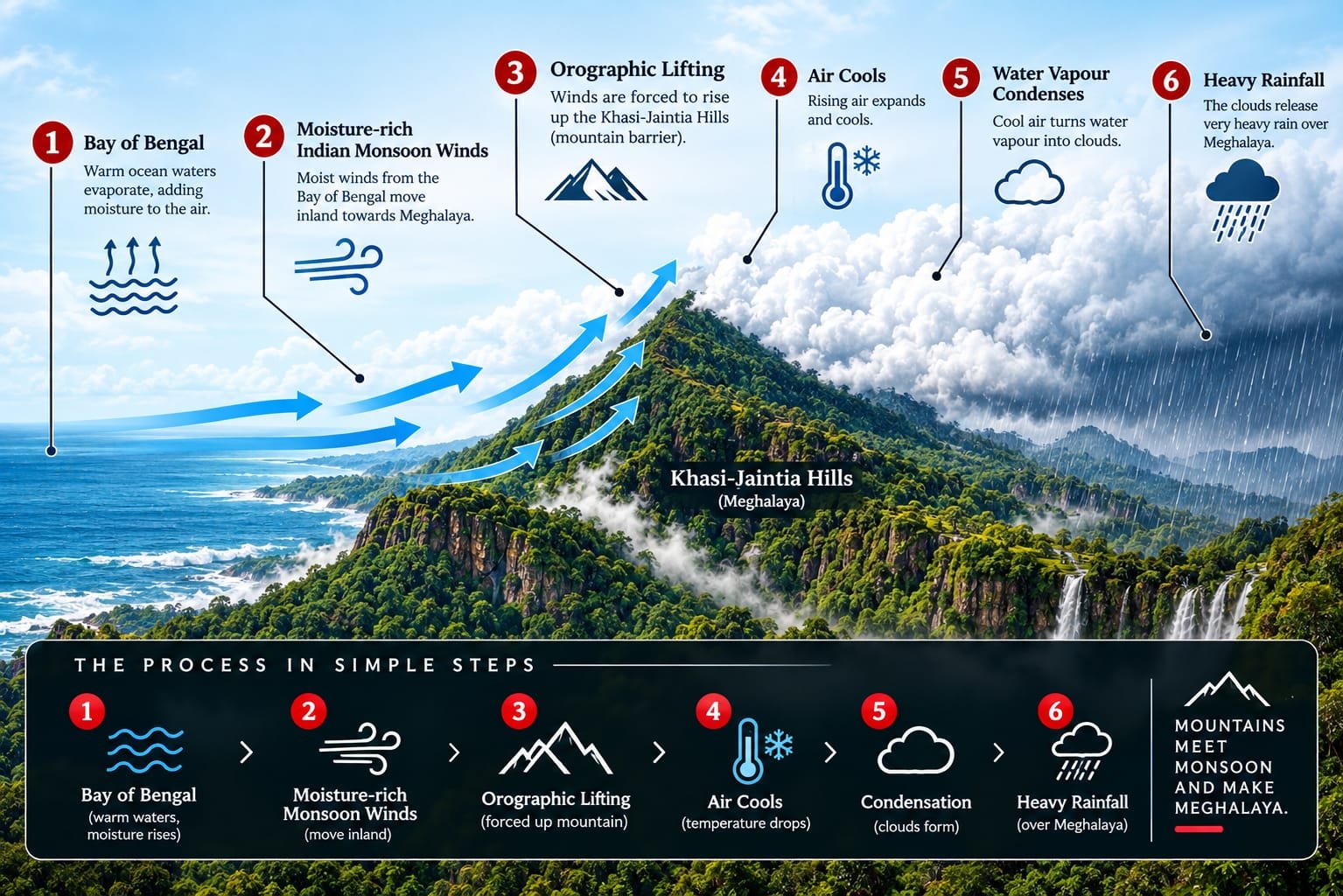
It is not a simple cause-and-effect story. The landscape influences the atmosphere, while the atmosphere continuously works on the landscape. And that is the fascinating bit. The same terrain that helps produce Meghalaya’s extraordinary rainfall is itself being reshaped by that rainfall.
So, Is Meghalaya Really the Land of Clouds?
Now the name starts to make rather more sense.
Meghalaya is not called the Land of Clouds simply because someone noticed that it always looked cloudy and decided the name sounded nice.
Its position in northeastern India places it in the path of moisture-rich monsoon air from the Bay of Bengal and the geological history helped produce the elevated Shillong Plateau and the steep Khasi-Jaintia Hills. Those hills force moist air upwards, allowing it to cool, condense and produce heavy rainfall.
And the rain does not stop falling from the sky. It continues its work on the ground, carving valleys, feeding waterfalls, shaping rivers and slowly dissolving limestone. So, in a way, Meghalaya is a meeting point between the atmosphere above and the ancient rocks below.
That is why “Land of Clouds” is not merely a beautiful nickname.
For Meghalaya, it is almost a description of how the place works.
 Arpital
 Abhisekd